
Percentage increase and decrease
Learning objectives
- Increase and decrease by a percentage
- Find percentage change
- Work backwards
This lesson on percentage increase and decrease shows you how to increase and decrease by a percentage, find percentage change, and work backwards (reverse percentages). It is tested on both the Foundation and Higher tiers of Edexcel IGCSE Maths A (4MA1), and the video builds each method step by step from a real problem. The video opens with this problem: a $50 jacket goes up by 20%, then is reduced by 20% in a sale. Is it back to $50?
What you will learn
Increase by r%: multiply by (1 + r/100), e.g. +15% → × 1.15
Decrease by r%: multiply by (1 − r/100), e.g. −35% → × 0.65
Percentage change = change ÷ original × 100
Reverse percentages: if you know the amount after the change, divide by the multiplier
Worked example
Increase 240 by 15%: 240 × 1.15 = 276
Decrease 80 by 35%: 80 × 0.65 = 52
60 → 75: change 15, 15 ÷ 60 × 100 = 25% increase
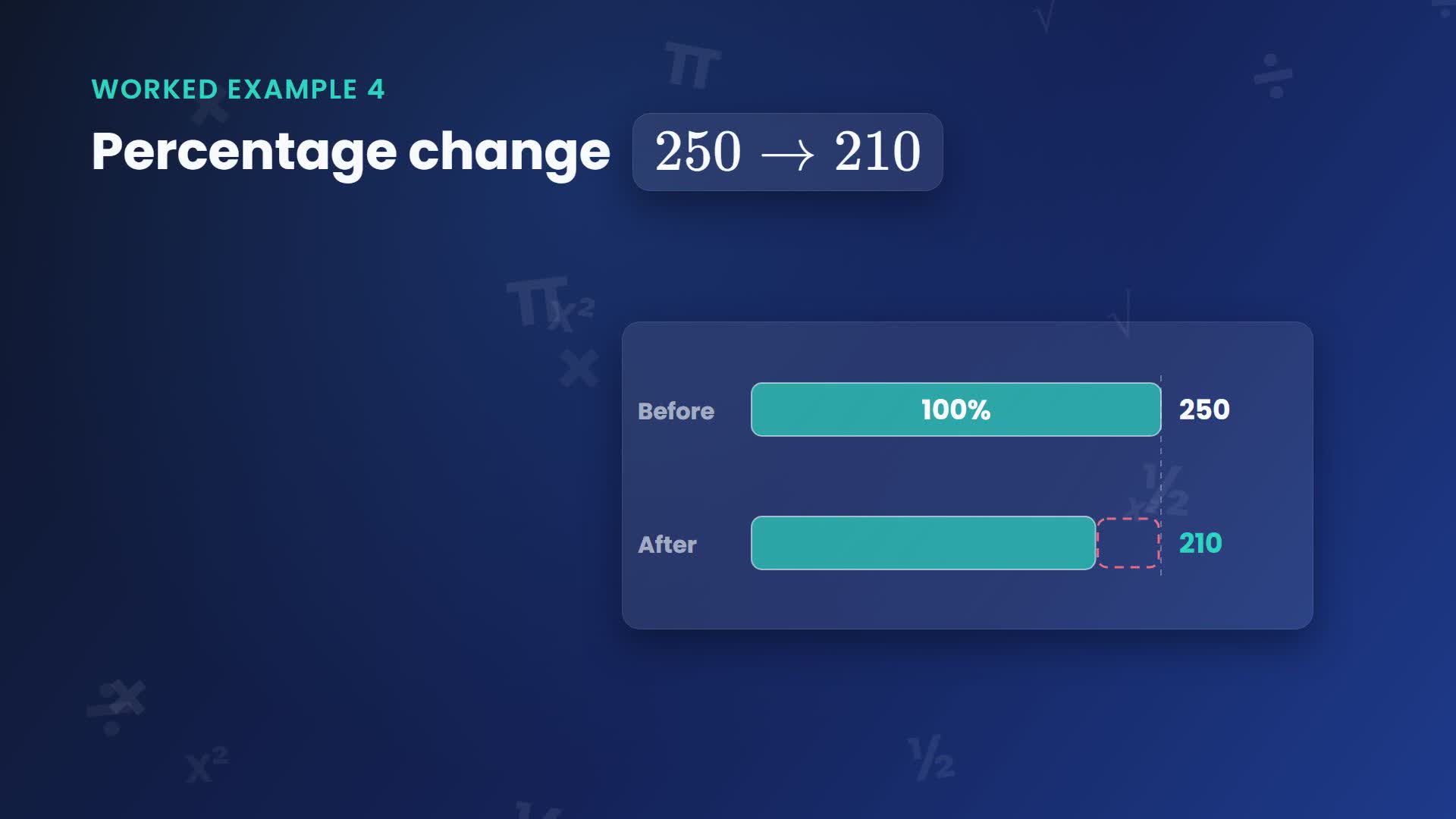
250 → 210: change 40, 40 ÷ 250 × 100 = 16% decrease
Opening problem: 50 × 1.2 = 60, then 60 × 0.8 = $48, so it is not back to $50
Try it yourself: (a) a $400 phone is reduced by 12%: 400 × 0.88 = $352 (b) a town grows from 1200 to 1350: 150 ÷ 1200 × 100 = 12.5% increase
Exam tips
Common mistake: for the reverse question, taking 20% of 84 and subtracting (84 − 16.80 = 67.20) ✗. The 20% was of the original, not of 84. Check: 70 × 1.2 = 84 ✓.
Remember: increase × (1 + r); decrease × (1 − r); change ÷ original × 100; reverse: divide by the multiplier.
- No questions yet. Be the first to ask!