
Standard form: writing and calculating
Learning objectives
- Write numbers in standard form
- Convert back
- Calculate with standard form
This lesson on standard form shows you how to write numbers in standard form, convert back, and calculate with standard form. It is tested on both the Foundation and Higher tiers of Edexcel IGCSE Maths A (4MA1), and the video builds each method step by step from a real problem. The video opens with this problem: the Sun is about 150 000 000 km from Earth, and a speck of dust can be 0.000 002 m wide. How do scientists write numbers like these without all the zeros?
What you will learn
Standard form is A × 10ⁿ, where 1 ≤ A < 10 and n is a whole number
Big numbers have a positive power. Small numbers (less than 1) have a negative power
The power counts how many places the decimal point moves
To multiply or divide, work with the numbers and the powers of 10 separately (index laws), then make sure A is between 1 and 10
Calculator: use the ×10ˣ (or EXP) key
Worked example
45 000 = 4.5 × 10⁴
0.000 37 = 3.7 × 10⁻⁴
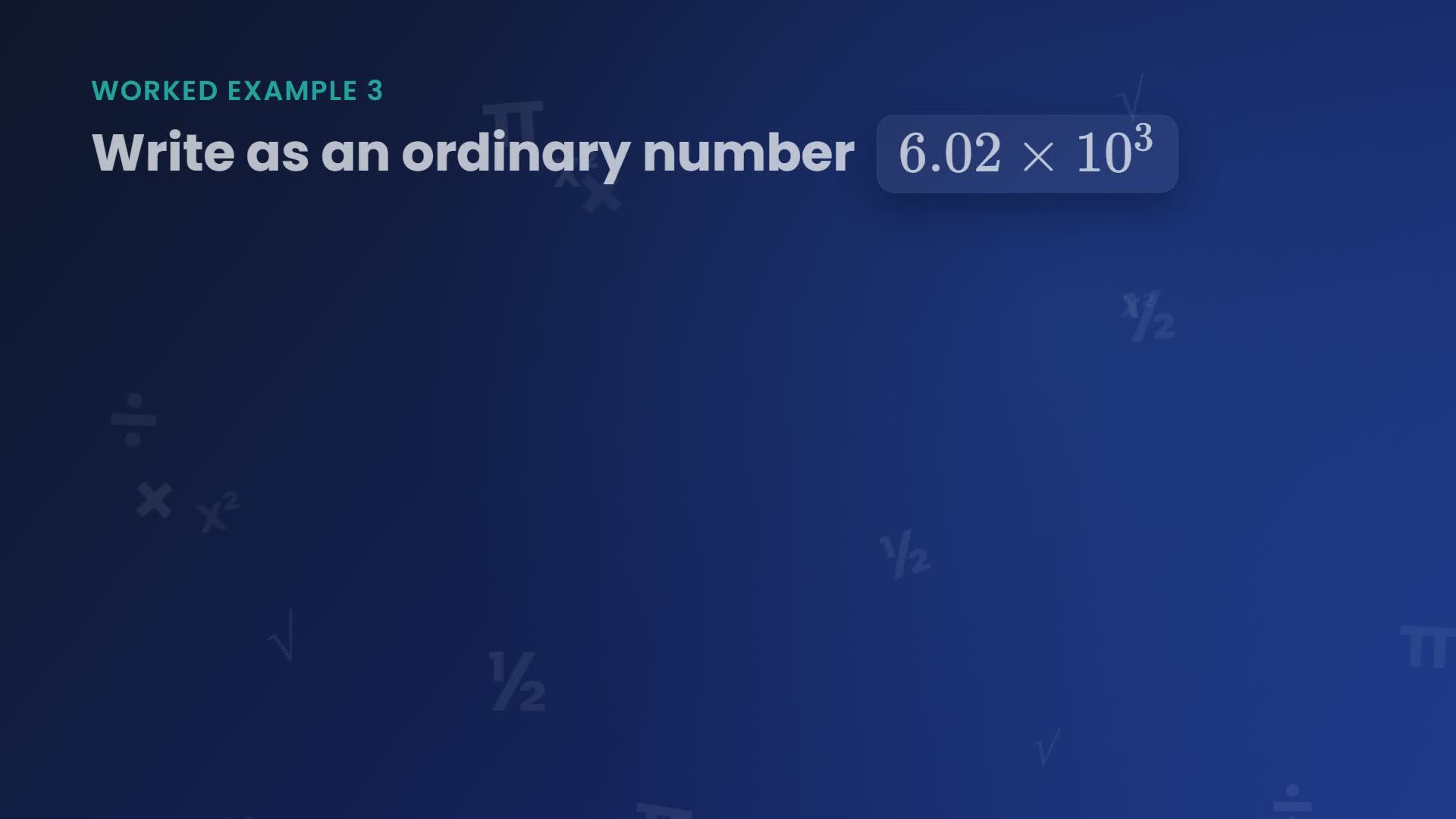
6.02 × 10³ = 6020
8 × 10⁻³ = 0.008
(3 × 10⁴) × (4 × 10⁵) = 12 × 10⁹ = 1.2 × 10¹⁰
Try it yourself: (a) 0.0062 → 6.2 × 10⁻³ (b) (5 × 10⁶) × (6 × 10⁻²) = 30 × 10⁴ = 3 × 10⁵
Exam tips
Common mistake: leaving 12 × 10⁹ as the final answer ✗, because 12 is not between 1 and 10. Fix: 1.2 × 10¹⁰. Also writing 0.000 37 as 3.7 × 10⁴ ✗: small numbers need a negative power.
Remember: A × 10ⁿ with 1 ≤ A < 10; big numbers: positive power; small numbers: negative power; always check A at the end.
- No questions yet. Be the first to ask!