
Finding the gradient of a straight line
Learning objectives
- Find the gradient of a straight line and understand what it means
- Solve exam-style questions on gradient of a straight line
- Avoid the most common mistakes in gradient of a straight line questions
This lesson on gradient of a straight line shows you how to find the gradient of a straight line and understand what it means. It is tested on both the Foundation and Higher tiers of Edexcel IGCSE Maths A (4MA1), and the video builds each method step by step from a real problem. The video opens with this problem: two slides in a park. Slide A rises 3 m over 4 m across. Slide B rises 2 m over 2 m across. Which is steeper?
What you will learn
Gradient = change in y ÷ change in x (rise over run). It measures steepness
Pick two points on the line, then count the squares up or down and across
Uphill from left to right = positive gradient. Downhill = negative. Horizontal = 0
A bigger number means a steeper line
Worked example
Line through (0, 1) and (2, 7): rise 6, run 2 → gradient 3
Line through (0, 5) and (4, 3): down 2, across 4 → gradient −1/2
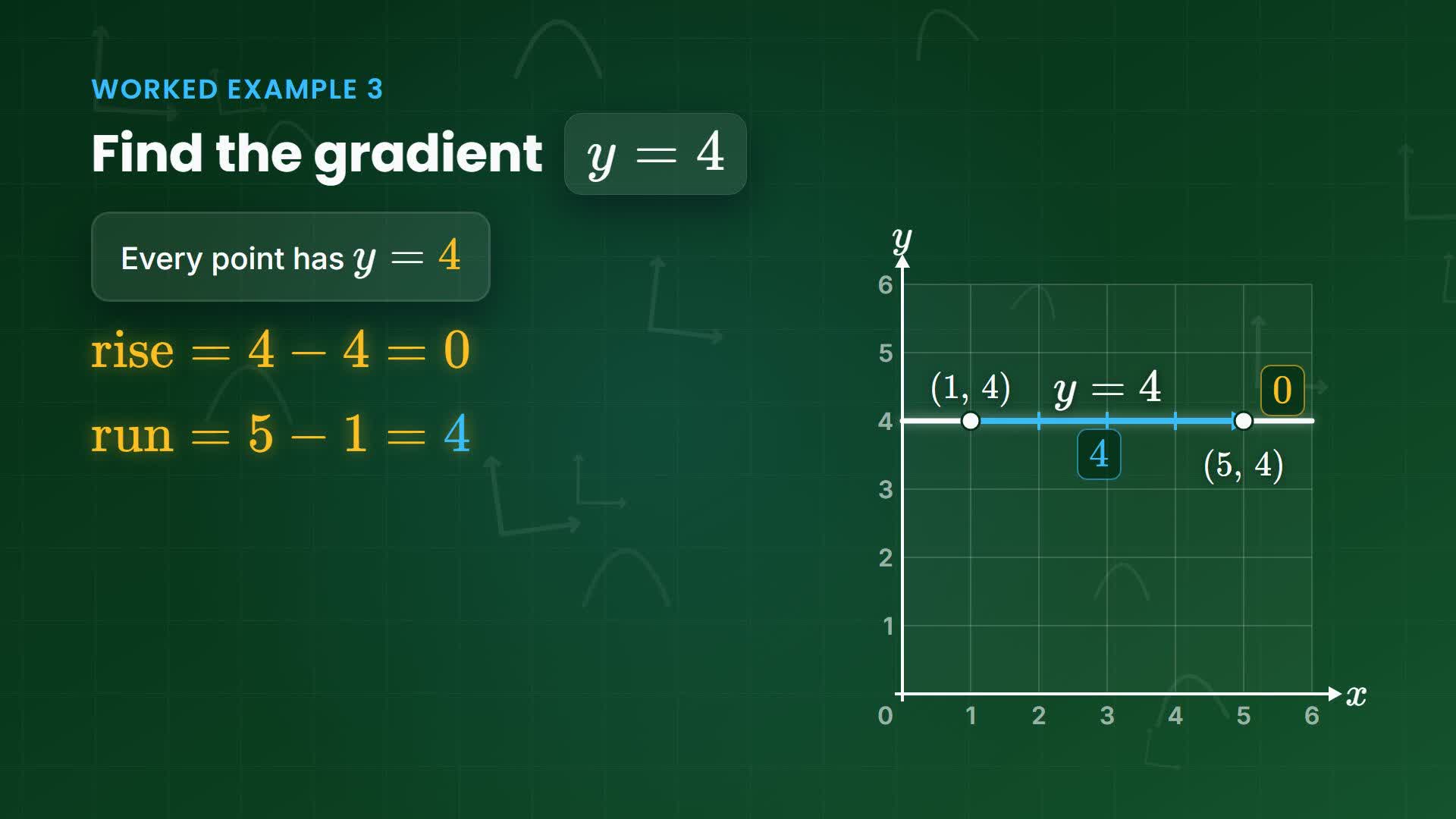
The horizontal line y = 4 → gradient 0
Opening problem: Slide A 3/4 = 0.75, Slide B 2/2 = 1 → Slide B is steeper
Try it yourself: (a) through (1, 2) and (4, 11) → rise 9, run 3 → 3 (b) through (−2, 6) and (2, −2) → down 8, across 4 → −2
Exam tips
Common mistake: run over rise (2/6) ✗, or forgetting the minus sign for a downhill line. Fix: always up (or down) first, then across.
Remember: gradient = rise ÷ run; positive goes up, negative goes down; horizontal = 0; gradient is a rate in real-life graphs.
Resources
- No questions yet. Be the first to ask!
The full transcript is available with the lesson.