
Sketching straight-line graphs with intercepts
Learning objectives
- Sketch straight lines quickly using their intercepts and gradient
- Solve exam-style questions on sketching straight line graphs
- Avoid the most common mistakes in sketching straight line graphs questions
This lesson on sketching straight line graphs shows you how to sketch straight lines quickly using their intercepts and gradient. It is tested on both the Foundation and Higher tiers of Edexcel IGCSE Maths A (4MA1), and the video builds each method step by step from a real problem. The video opens with this problem: you don't always need a full table of values. Two points are enough to draw a straight line.
What you will learn
A sketch shows the shape and the key points (the intercepts). It doesn't need to be drawn to scale
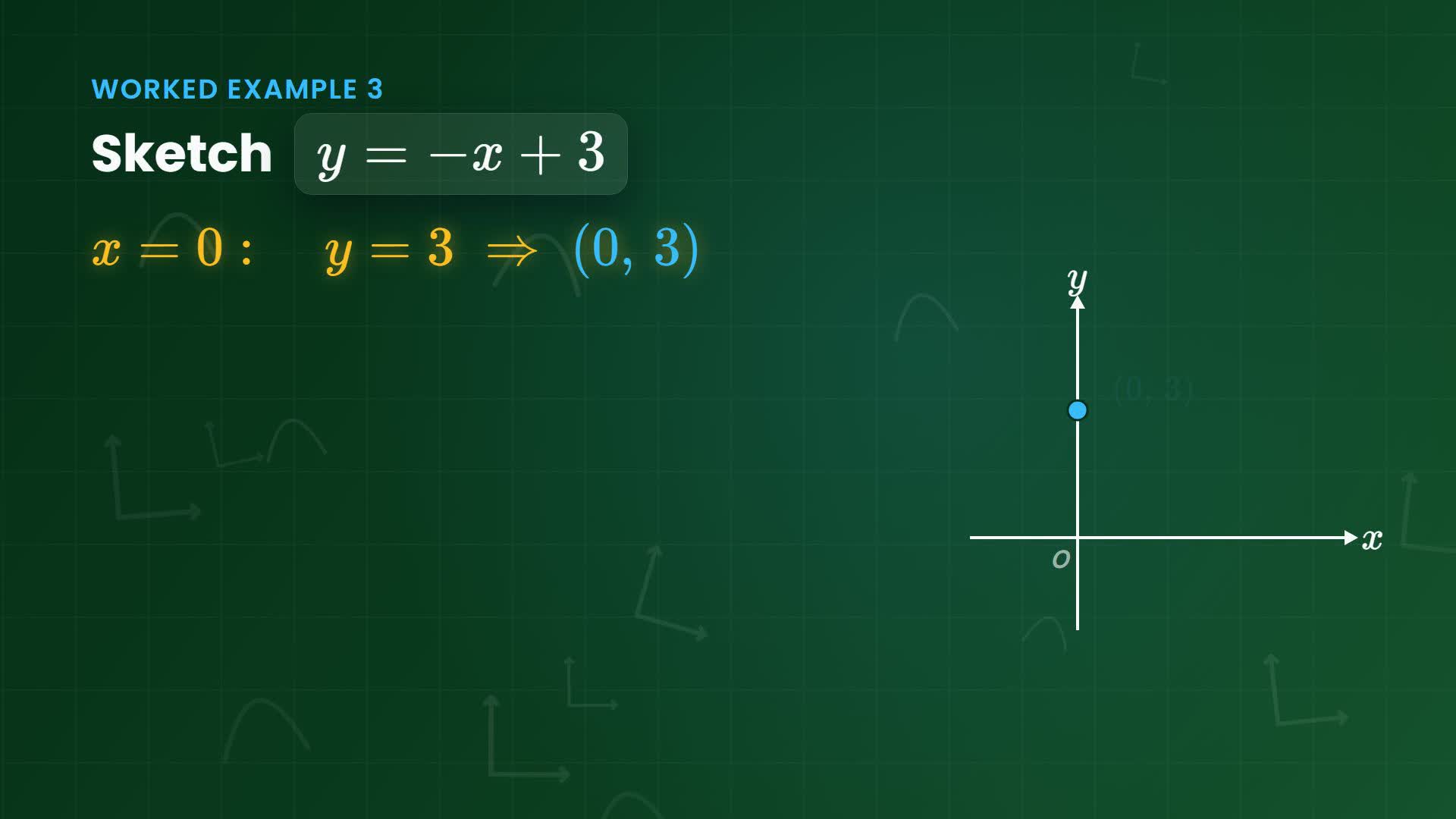
y-intercept: put x = 0. x-intercept: put y = 0
The cover-up method for ax + by = c: cover the x term to find the y-intercept, then cover the y term to find the x-intercept
Check the direction: a positive gradient goes uphill, a negative gradient goes downhill
Worked example
y = 2x − 4: y-intercept (0, −4); x-intercept 0 = 2x − 4 → (2, 0). Sketch an uphill line through both points.
3x + 2y = 12: cover-up gives (4, 0) and (0, 6). Sketch a downhill line.
y = −x + 3: (0, 3) and (3, 0)
Special lines: sketch y = 5 (horizontal) and x = −2 (vertical).
Try it yourself: sketch 4x − 2y = 8: y = 0 → x = 2, giving (2, 0); x = 0 → −2y = 8 → y = −4, giving (0, −4). It's an uphill line.
Exam tips
Common mistake: finding the x-intercept by putting x = 0 ✗. The x-intercept is where y = 0.
Remember: x = 0 gives the y-intercept; y = 0 gives the x-intercept; cover-up for ax + by = c; check uphill or downhill.
Resources
- No questions yet. Be the first to ask!
The full transcript is available with the lesson.