
Equations of straight lines: y = mx + c
Learning objectives
- Find the equation of a line
- Rearrange equations into y = mx + c
- Recognise parallel lines
This lesson on y = mx + c shows you how to find the equation of a line, rearrange equations into y = mx + c, and recognise parallel lines. It is tested on both the Foundation and Higher tiers of Edexcel IGCSE Maths A (4MA1), and the video builds each method step by step from a real problem. The video opens with this problem: two lines on a map never meet. How can you tell just from their equations?
What you will learn
Quick recap from Unit 1: in y = mx + c, m is the gradient and c is the y-intercept
Writing an equation: read c where the line crosses the y-axis, find m from rise ÷ run, then write y = mx + c
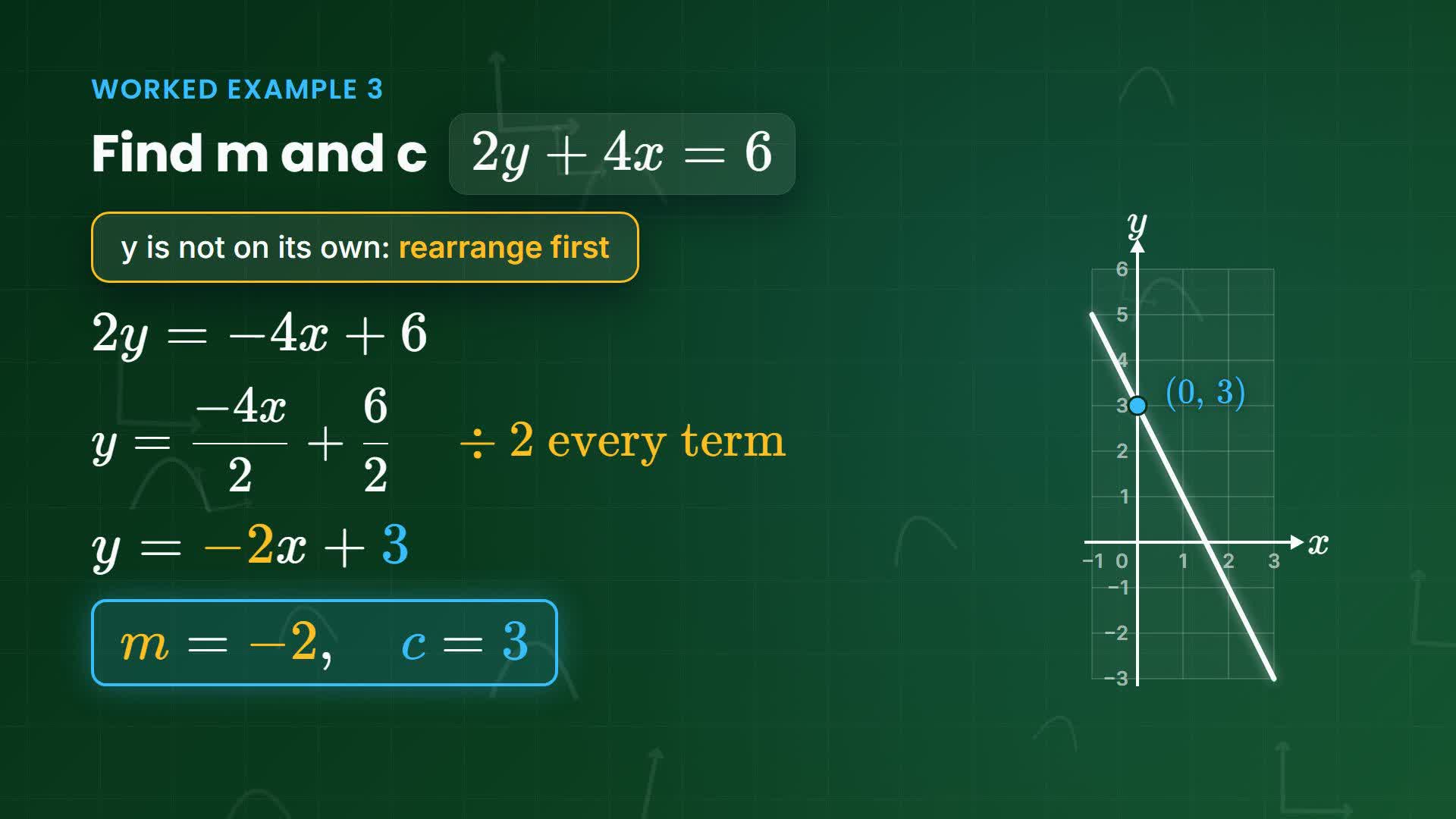
Equations not in y = mx + c form: rearrange to make y the subject before reading m and c
Parallel lines have the same gradient
To test whether a point lies on a line, substitute its x-value and check the y-value
Worked example
A line crosses the y-axis at 3 and has gradient 2 → y = 2x + 3
Gradient 4 through (0, −1) → y = 4x − 1
Try it yourself: (a) 4y = 8x − 12 → y = 2x − 3 → m = 2, c = −3 (b) the line parallel to y = −x + 2 through (0, 5) → y = −x + 5
Exam tips
Common mistake: reading c = 6 from 2y + 4x = 6 ✗. You must make y the subject first: y = −2x + 3, so c = 3.
Remember: y = mx + c; make y the subject first; parallel = same gradient; substitute to test a point.
Resources
- No questions yet. Be the first to ask!
The full transcript is available with the lesson.