
Circle theorems part 2: cyclic quadrilaterals
Shape and Space 2 · Unit 2 · 8:00
Learning objectives
- Use three more circle theorems
- Combine theorems in multi-step problems
- Solve exam-style questions on cyclic quadrilateral theorem
This lesson on cyclic quadrilateral theorem shows you how to use three more circle theorems, and combine theorems in multi-step problems. It is tested on the Higher tier of Edexcel IGCSE Maths A (4MA1), and the video builds each method step by step from a real problem. The video opens with this problem: draw any four points on a circle and join them. Why do the opposite angles always add up to 180°?
What you will learn
Angles in the same segment are equal (angles standing on the same chord, on the same side)
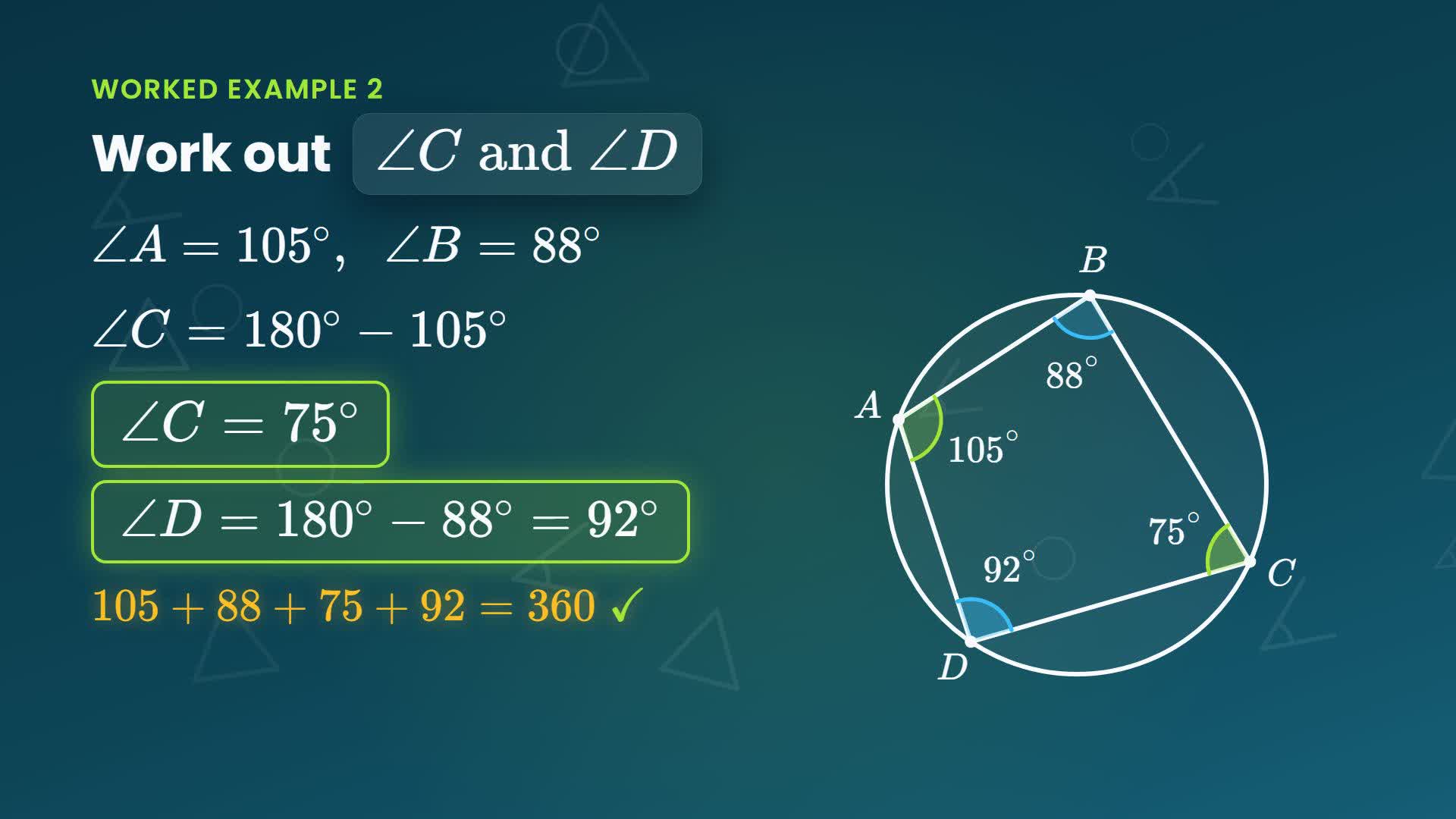
Opposite angles of a cyclic quadrilateral add up to 180°. All four corners must be on the circle
Alternate segment theorem: the angle between a tangent and a chord equals the angle in the alternate segment
Exam reasons: use the full theorem names exactly as above
Worked example
Angle ADB = 42° → angle ACB = 42° (angles in the same segment)
Cyclic quadrilateral ABCD: angle A = 105° → angle C = 75°; angle B = 88° → angle D = 92°
Opposite angles x and 2x + 30 in a cyclic quadrilateral → 3x + 30 = 180 → x = 50 → 50° and 130°
Try it yourself: (a) opposite angles 3y and y + 20 in a cyclic quadrilateral → 4y + 20 = 180 → y = 40 → 120° and 60° (b) the angle between a tangent and a chord is 64° → the angle in the alternate segment is 64°
Exam tips
Common mistake: using the cyclic quadrilateral rule when one corner is the centre ✗. All four corners must be on the circle.
Remember: same segment angles are equal; cyclic quadrilateral opposite angles add to 180°; alternate segment theorem; use the full theorem names as reasons.
Resources
- No questions yet. Be the first to ask!
The full transcript is available with the lesson.