
Properties of quadrilaterals and their angles
Shape and Space 1 · Unit 1 · 6:25
Learning objectives
- Know the properties of special quadrilaterals and find missing angles
- Solve exam-style questions on properties of quadrilaterals
- Avoid the most common mistakes in properties of quadrilaterals questions
This lesson on properties of quadrilaterals shows you how to know the properties of special quadrilaterals and find missing angles. It is tested on both the Foundation and Higher tiers of Edexcel IGCSE Maths A (4MA1), and the video builds each method step by step from a real problem. The video opens with this problem: is a square a rectangle? Is a rectangle a square?
What you will learn
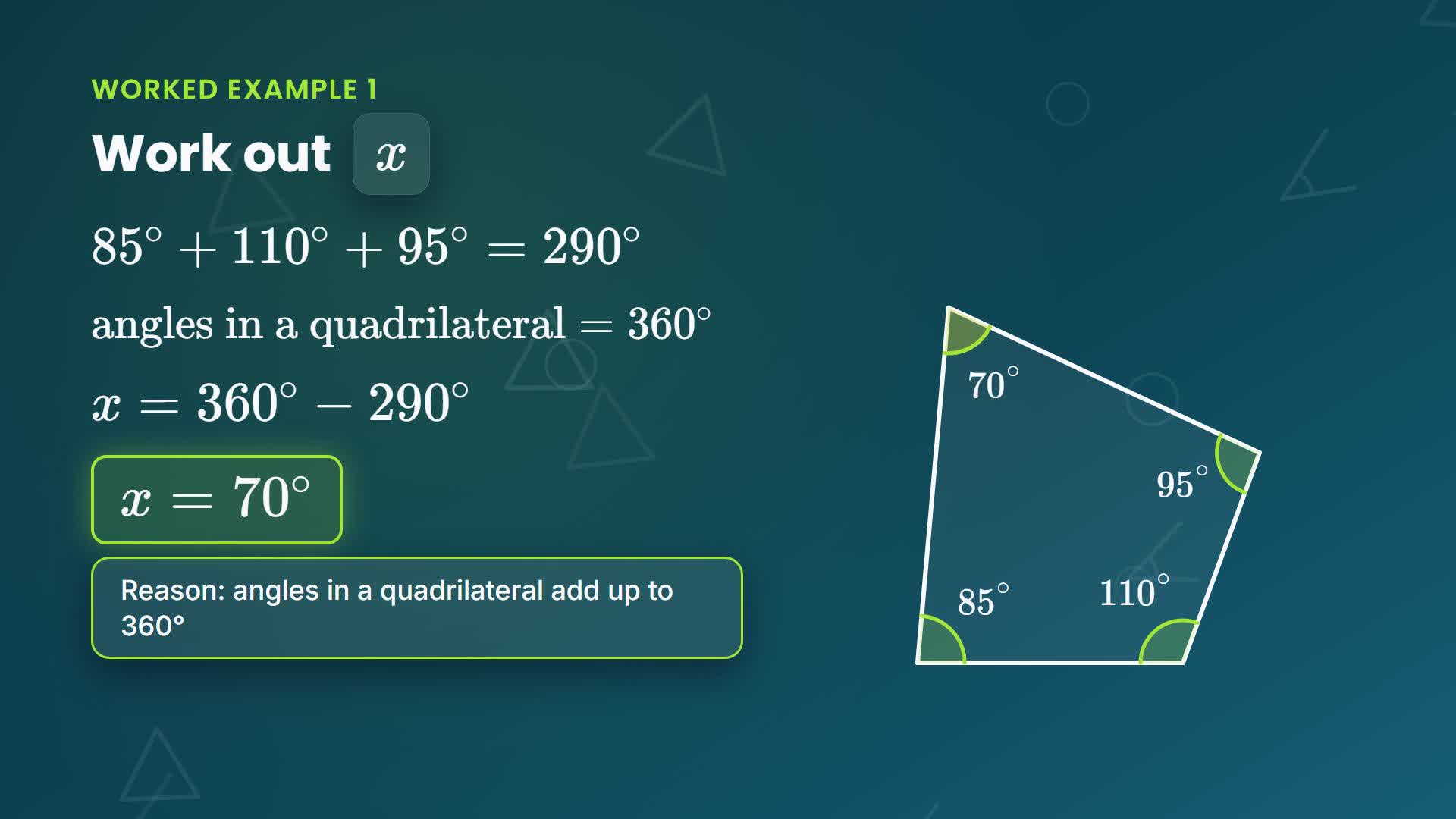
Angles in a quadrilateral add to 360° (split it into two triangles: 2 × 180°)
Parallel lines: co-interior angles add to 180°, so neighbouring angles in a parallelogram add to 180°
Worked example
Angles 85°, 110°, 95° and x → x = 360 − 290 = 70°
Parallelogram with one angle of 64° → the other angles are 116°, 64°, 116°
Kite with angles 120°, 70° and two equal angles x → 2x = 170 → x = 85°
Isosceles trapezium with base angles of 72° → the top angles are 108° each
Identify the shape: four equal sides, no right angles → rhombus; exactly one pair of parallel sides → trapezium
Try it yourself: a quadrilateral has angles 3x, 2x, 100° and 110° → 5x = 150 → x = 30 → the angles are 90° and 60°
Exam tips
Common mistake: thinking the diagonals of a rhombus are equal in length ✗. They cross at 90° but are usually different lengths. Only in a square are they both equal and perpendicular.
Remember: quadrilateral angles add to 360°; learn each shape's sides, angles and diagonals; a square is a special rectangle and a special rhombus.
Resources
- No questions yet. Be the first to ask!
The full transcript is available with the lesson.
Shape and Space in other units
- Unit 2 · Shape and Space 2 Pythagoras' theorem in right-angled triangles
- Unit 2 · Shape and Space 2 Circle theorems part 1: tangents and centre angles
- Unit 2 · Shape and Space 2 Circle theorems part 2: cyclic quadrilaterals
- Unit 2 · Shape and Space 2 Shape and Space 2 revision: Pythagoras and circles