
Interior and exterior angles in polygons
Shape and Space 1 · Unit 1 · 7:22
Learning objectives
- Find interior and exterior angles of polygons
- Including regular polygons
- Solve exam-style questions on interior and exterior angles
This lesson on interior and exterior angles shows you how to find interior and exterior angles of polygons, including regular polygons. It is tested on both the Foundation and Higher tiers of Edexcel IGCSE Maths A (4MA1), and the video builds each method step by step from a real problem. The video opens with this problem: why do honeycomb cells use regular hexagons?
What you will learn
Polygon names: pentagon (5), hexagon (6), heptagon (7), octagon (8), nonagon (9), decagon (10)
Sum of interior angles = (n − 2) × 180°
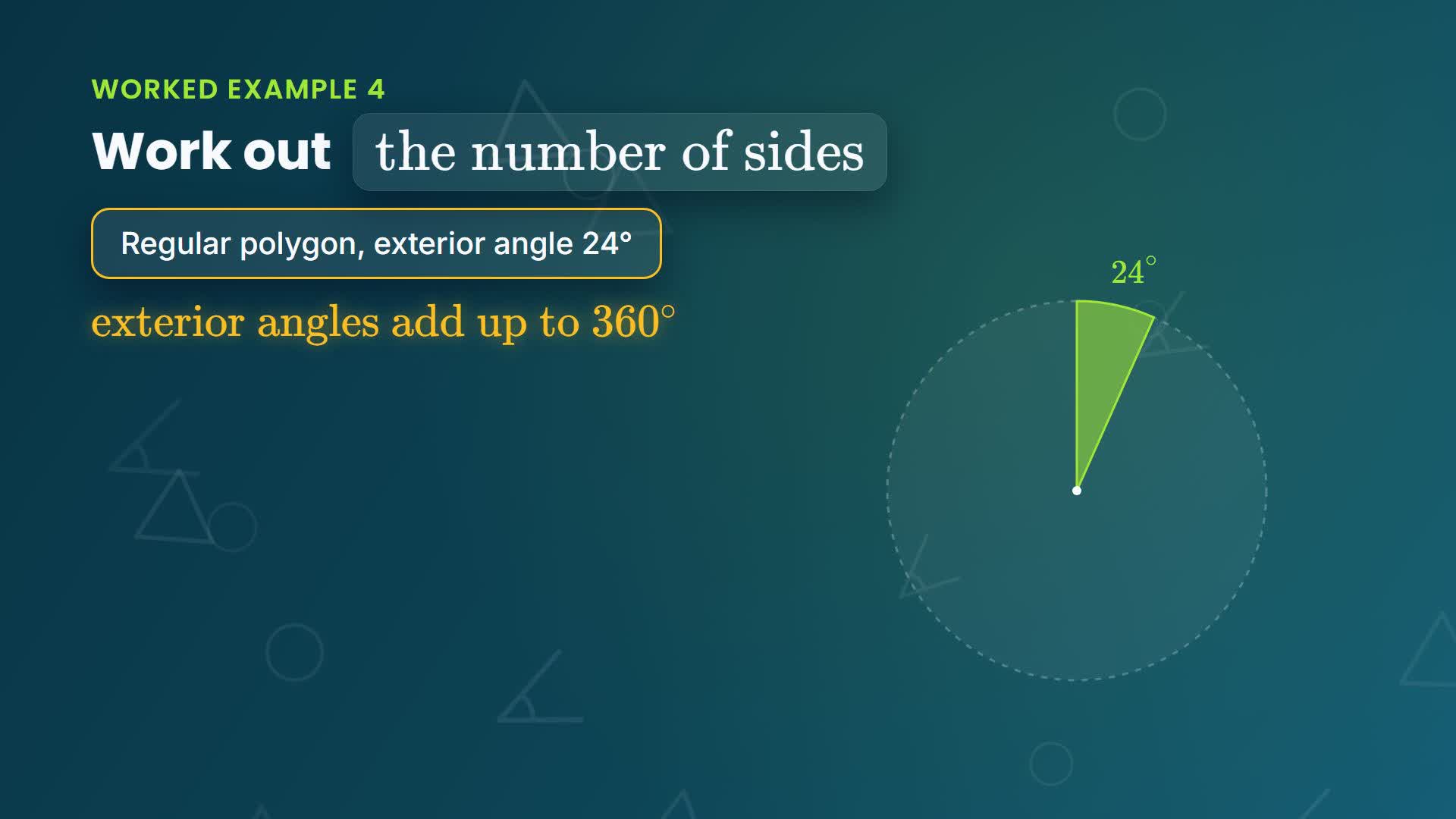
Exterior angles of any polygon add to 360°
Regular polygon: exterior angle = 360° ÷ n, and interior angle = 180° − exterior angle
Worked example
Sum of the interior angles of a pentagon: 3 × 180 = 540°
Regular hexagon: exterior 60°, interior 120°
Regular decagon: exterior 36°, interior 144°
A regular polygon has exterior angle 24° → n = 360 ÷ 24 = 15 sides
A regular polygon has interior angle 160° → exterior 20° → 18 sides
Irregular pentagon with angles 100°, 120°, 95°, 110° and x → x = 540 − 425 = 115°
Try it yourself: (a) interior angle of a regular octagon → exterior 45° → 135° (b) can a regular polygon have an exterior angle of 50°? 360 ÷ 50 = 7.2, not a whole number → no
Exam tips
Common mistake: using 360° for the interior angle sum of every polygon ✗, or n × 180 ✗. Fix: (n − 2) × 180.
Remember: interior sum = (n − 2) × 180; exterior angles add to 360; regular: exterior = 360 ÷ n; interior + exterior = 180.
Resources
- No questions yet. Be the first to ask!
The full transcript is available with the lesson.
Shape and Space in other units
- Unit 2 · Shape and Space 2 Pythagoras' theorem in right-angled triangles
- Unit 2 · Shape and Space 2 Circle theorems part 1: tangents and centre angles
- Unit 2 · Shape and Space 2 Circle theorems part 2: cyclic quadrilaterals
- Unit 2 · Shape and Space 2 Shape and Space 2 revision: Pythagoras and circles