
Shape and Space 1 revision: angles and shapes
Shape and Space 1 · Unit 1 · 5:07
Learning objectives
- Recall the key methods from Shape and Space 1
- Answer quick-fire questions under time pressure
- Identify which Shape and Space 1 topics to revise before the quiz
This angles and polygons revision video brings together everything from Shape and Space 1 in one short lesson. It recaps the key methods, then tests you with quick-fire exam-style questions so you can see what to revise. It covers content from both the Foundation and Higher tiers of Edexcel IGCSE Maths A (4MA1).
What you will learn
Angles in triangles and angle facts
Properties of quadrilaterals and their angles
Interior and exterior angles in polygons
Constructions with ruler and compasses
Similar triangles and scale factors
Worked example
These are the quick-fire questions from the video. Try each one before you check the answer.
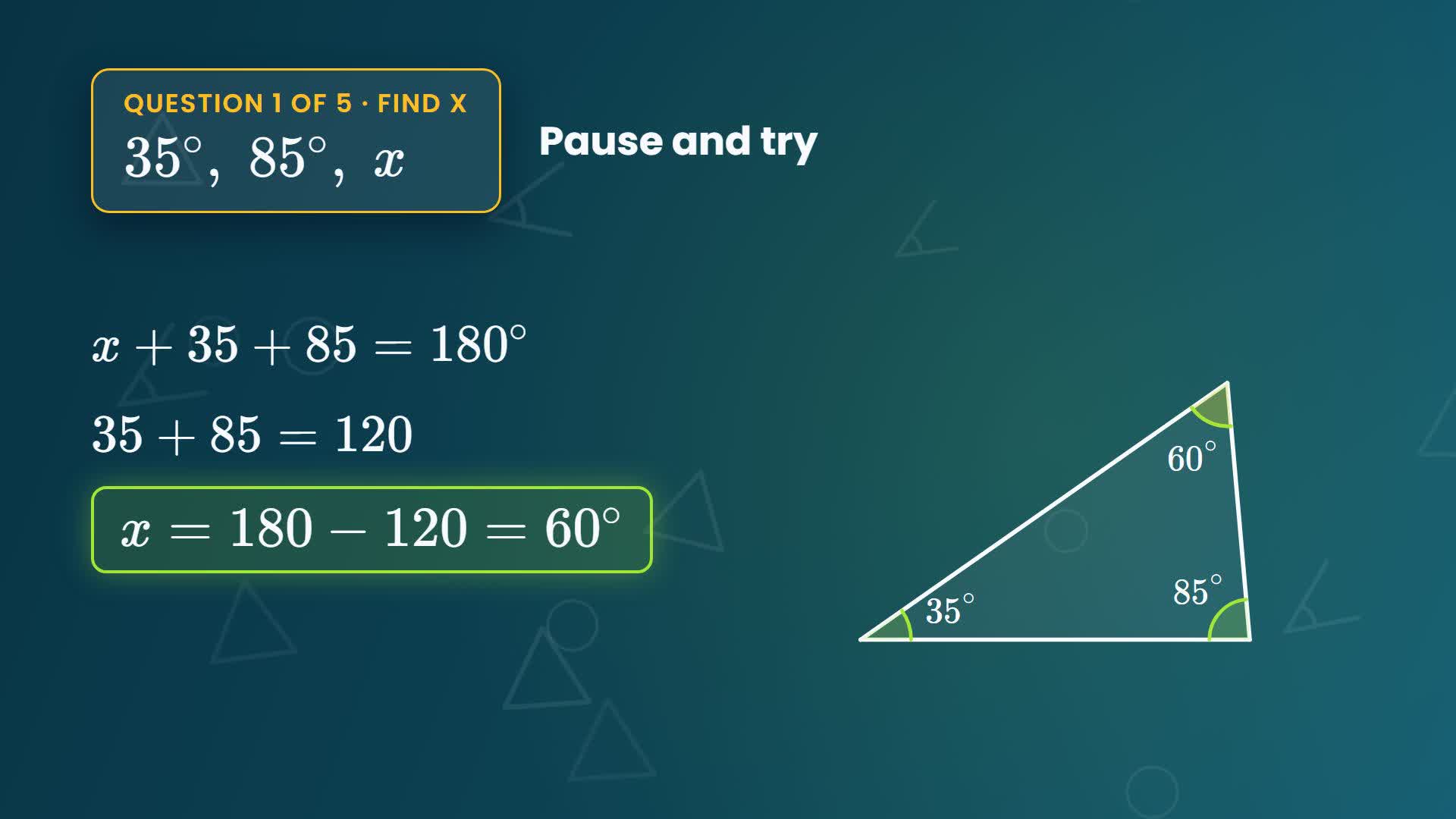
Triangle angles 35°, 85° and x → 60°
A parallelogram has an angle of 72°. Find the angle next to it → 108°
Interior angle of a regular pentagon → 108°
A regular polygon has an exterior angle of 30°. How many sides? → 12
Similar shapes: 4 cm becomes 10 cm. What does 6 cm become? → scale factor 2.5 → 15 cm
Exam tips
Pause the video and try each question before the answer appears, exactly as you would in the exam
Write down your working, even for short questions, because method marks are often given for a correct method
Rewatch the lesson for any question you got wrong, then take the full section quiz below the video
Use this recap again in the weeks before your exam to check you still remember the Shape and Space 1 methods
Resources
- No questions yet. Be the first to ask!
The full transcript is available with the lesson.
Shape and Space in other units
- Unit 2 · Shape and Space 2 Pythagoras' theorem in right-angled triangles
- Unit 2 · Shape and Space 2 Circle theorems part 1: tangents and centre angles
- Unit 2 · Shape and Space 2 Circle theorems part 2: cyclic quadrilaterals
- Unit 2 · Shape and Space 2 Shape and Space 2 revision: Pythagoras and circles