
Similar triangles and scale factors
Shape and Space 1 · Unit 1 · 6:44
Learning objectives
- Recognise similar triangles and find missing sides using a scale factor
- Solve exam-style questions on similar triangles
- Avoid the most common mistakes in similar triangles questions
This lesson on similar triangles shows you how to recognise similar triangles and find missing sides using a scale factor. It is tested on both the Foundation and Higher tiers of Edexcel IGCSE Maths A (4MA1), and the video builds each method step by step from a real problem. The video opens with this problem: how can you find the height of a tree using only its shadow? A 1.5 m stick casts a 2 m shadow. The tree's shadow is 12 m.
What you will learn
Similar shapes: the same shape with equal angles, and every side multiplied by the same scale factor
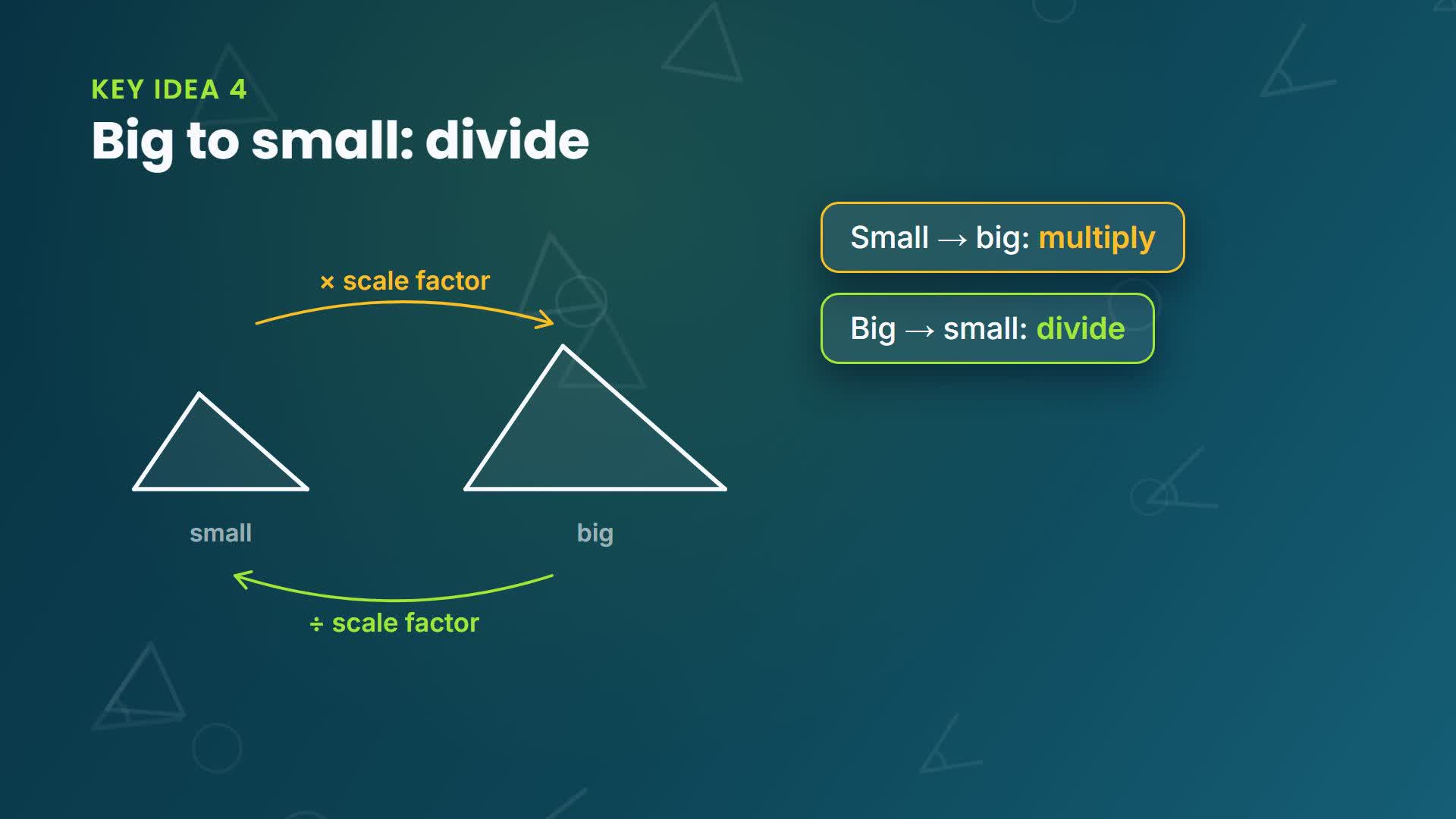
Scale factor = new length ÷ original length, using a pair of matching (corresponding) sides
To go from big to small, divide by the scale factor
Worked example
Triangle with sides 3, 4 and 5. In a similar triangle, the side matching 3 is 6 → scale factor 2 → the other sides are 8 and 10
Triangle with sides 8, 10 and 12 cm. In a similar triangle, the side matching 8 is 12 → scale factor 1.5 → 15 cm and 18 cm
Scale factor 1.5, larger side 9 cm → smaller side 9 ÷ 1.5 = 6 cm
Try it yourself: two similar triangles have matching sides of 5 cm and 7.5 cm. Another side of the small triangle is 4 cm. Scale factor 1.5 → 6 cm
Exam tips
Common mistake: adding instead of multiplying ✗ (6 is 3 more than 3, so add 3 to each side). Similar shapes always use multiplication.
Remember: similar = equal angles and sides in the same ratio; scale factor = new ÷ original; multiply to enlarge, divide to shrink; match the sides first.
Resources
- No questions yet. Be the first to ask!
The full transcript is available with the lesson.
Shape and Space in other units
- Unit 2 · Shape and Space 2 Pythagoras' theorem in right-angled triangles
- Unit 2 · Shape and Space 2 Circle theorems part 1: tangents and centre angles
- Unit 2 · Shape and Space 2 Circle theorems part 2: cyclic quadrilaterals
- Unit 2 · Shape and Space 2 Shape and Space 2 revision: Pythagoras and circles