
Equations with unknowns on both sides
Learning objectives
- Solve equations with the unknown on both sides
- With brackets
- From word problems
This lesson on unknowns on both sides shows you how to solve equations with the unknown on both sides, with brackets, and from word problems. It is tested on both the Foundation and Higher tiers of Edexcel IGCSE Maths A (4MA1), and the video builds each method step by step from a real problem. The video opens with this problem: two taxi firms. Firm A charges $3 plus $2 per km. Firm B charges $9 plus $1.50 per km. For what distance do they cost the same?
What you will learn
Unknown on both sides: move the x terms to the side with more x, so the coefficient stays positive
Brackets: expand first, then solve
Answers can be negative or decimals. Always check
Word problems: choose a letter, write an equation from the words, solve, and answer in context with units
Worked example
5x + 3 = 2x + 18 → 3x = 15 → x = 5
7x − 4 = 3x + 10 → 4x = 14 → x = 3.5
2x + 9 = 5x − 6 → 15 = 3x → x = 5
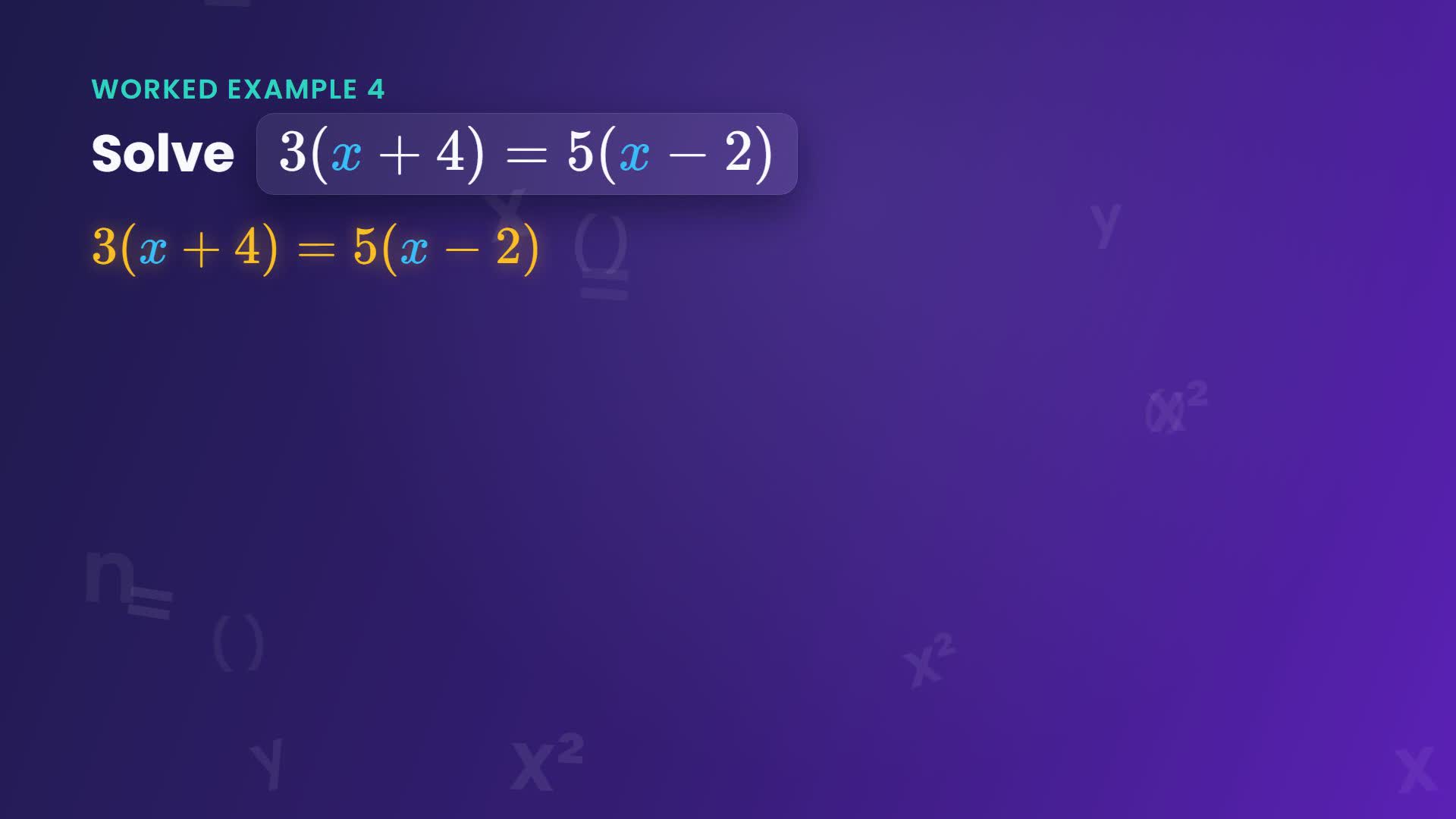
3(x + 4) = 5(x − 2) → 3x + 12 = 5x − 10 → 22 = 2x → x = 11
Try it yourself: 2(3x − 1) = 4x + 9 → 6x − 2 = 4x + 9 → 2x = 11 → x = 5.5
Exam tips
Common mistake: 5x + 3 = 2x + 18 → 7x = 21 ✗ (added 2x instead of subtracting it). Fix: subtract 2x from both sides → 3x + 3 = 18.
Remember: collect x on the side with more x; expand brackets first; negative and decimal answers are fine; check by substituting.
Resources
- No questions yet. Be the first to ask!
The full transcript is available with the lesson.