
Solving equations with roots and powers
Learning objectives
- Solve equations involving squares
- Square roots and cubes
- Solve exam-style questions on equations with squares and roots
This lesson on equations with squares and roots shows you how to solve equations involving squares, square roots and cubes. It is tested on both the Foundation and Higher tiers of Edexcel IGCSE Maths A (4MA1), and the video builds each method step by step from a real problem. The video opens with this problem: a square garden has an area of 81 m². How long is each side?
What you will learn
Squaring and square-rooting undo each other. So do cubing and cube-rooting
x² = 49 has two answers: x = 7 or x = −7 (written ±7), because (−7)² = 49 too
x³ = 64 has only one answer, x = 4. A negative cube gives a negative answer: x³ = −27 → x = −3
In real-life problems, reject answers that make no sense, such as a negative length
Worked example
x² = 49 → x = ±7
√x = 5 → x = 25
x³ = 64 → x = 4; x³ = −27 → x = −3
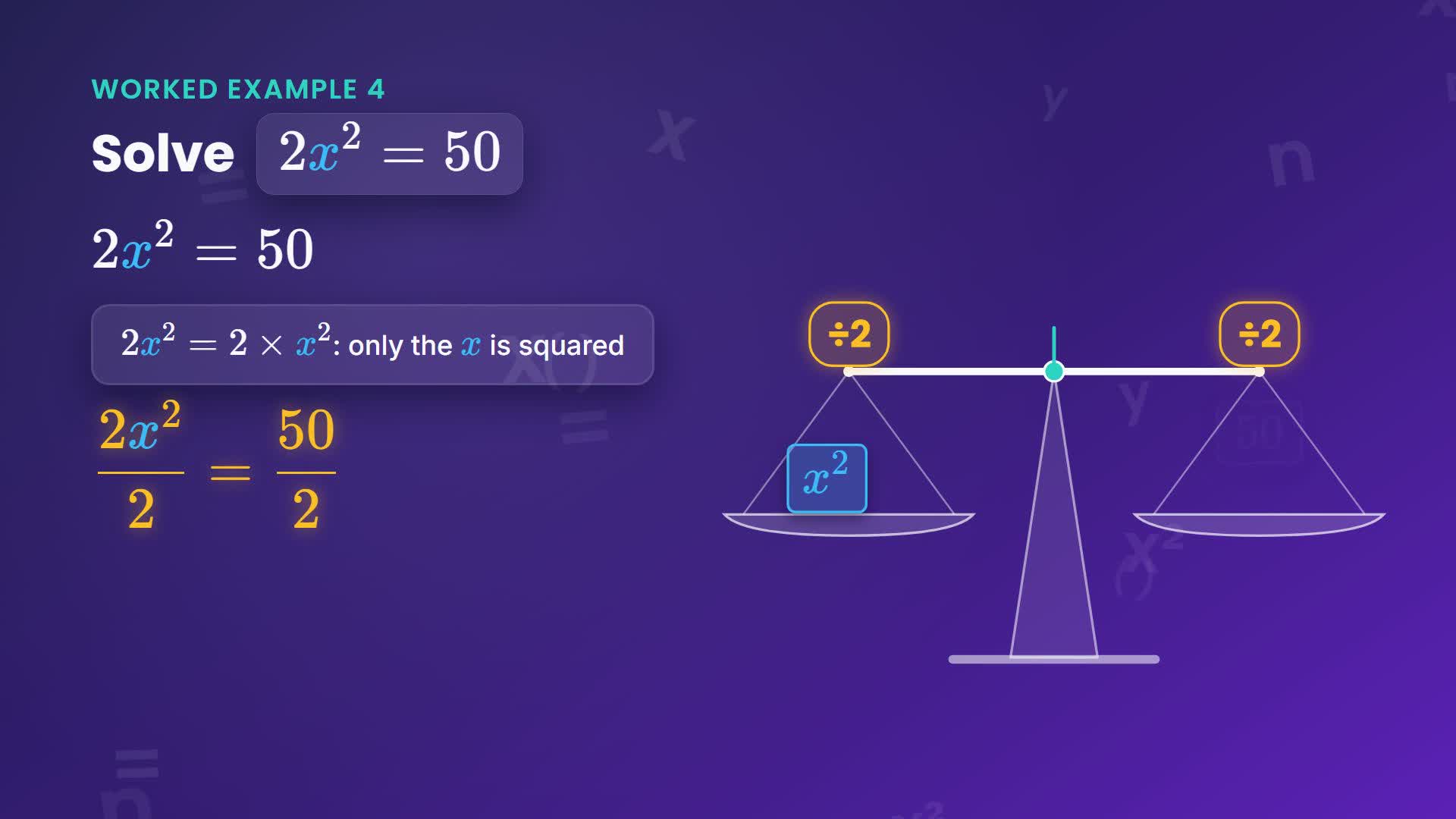
2x² = 50 → x² = 25 → x = ±5
x²/3 + 4 = 16 → x²/3 = 12 → x² = 36 → x = ±6
(x − 3)² = 16 → x − 3 = ±4 → x = 7 or x = −1
Try it yourself: (a) 3x² = 75 → x² = 25 → x = ±5 (b) √(2x) = 6 → 2x = 36 → x = 18
Exam tips
Common mistake: x² = 49 → x = 7 only ✗ (forgetting −7). Also x² = 49 → x = 24.5 ✗ (halving instead of square-rooting).
Remember: square ↔ square root; x² = k has two answers (±); cubes have one answer; reject impossible answers in context.
Resources
- No questions yet. Be the first to ask!
The full transcript is available with the lesson.