
Solving linear inequalities on a number line
Learning objectives
- Use inequality symbols
- Show inequalities on a number line
- List integer solutions and solve inequalities
This lesson on linear inequalities shows you how to use inequality symbols, show inequalities on a number line, list integer solutions and solve inequalities. It is tested on both the Foundation and Higher tiers of Edexcel IGCSE Maths A (4MA1), and the video builds each method step by step from a real problem. The video opens with this problem: a lift can carry at most 600 kg. The operator weighs 75 kg and each box weighs 45 kg. How many boxes can go in?
What you will learn
Symbols: < less than, > greater than, ≤ less than or equal to, ≥ greater than or equal to
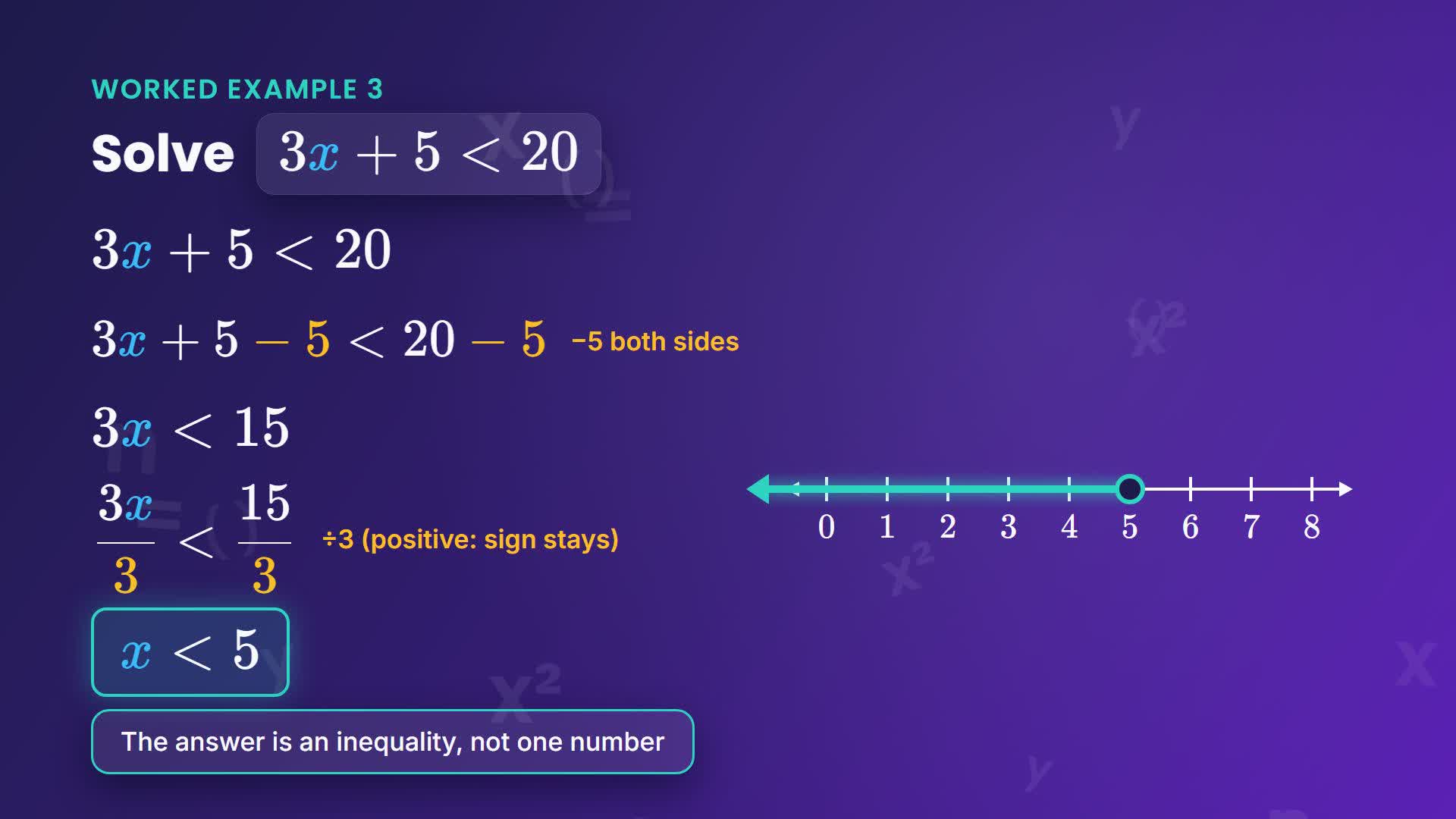
Number lines: an open circle for < or >, a closed (filled) circle for ≤ or ≥
Solve like an equation: do the same to both sides
The one new rule: multiplying or dividing by a negative number flips the inequality sign
Double inequalities: do the same to all three parts
Worked example
Integers that satisfy −3 < n ≤ 2 → −2, −1, 0, 1, 2
3x + 5 < 20 → 3x < 15 → x < 5
Try it yourself: (a) 4x − 7 ≤ 13 → x ≤ 5 (b) integers with 1 < 3n − 2 ≤ 10 → 3 < 3n ≤ 12 → 1 < n ≤ 4 → 2, 3, 4
Exam tips
Common mistake: −2x > 6 → x > −3 ✗ (not flipping the sign). Test with x = 0: 5 − 0 > 11 is false, so x > −3 can't be right. Correct: x < −3.
Remember: open circle for < or >, closed for ≤ or ≥; solve like an equation; flip the sign when multiplying or dividing by a negative.
Resources
- No questions yet. Be the first to ask!
The full transcript is available with the lesson.