
Solving linear equations: one and two steps
Learning objectives
- Solve one-step and two-step equations
- Including ones with brackets
- Solve exam-style questions on solving linear equations
This lesson on solving linear equations shows you how to solve one-step and two-step equations, including ones with brackets. It is tested on both the Foundation and Higher tiers of Edexcel IGCSE Maths A (4MA1), and the video builds each method step by step from a real problem. The video opens with this problem: i think of a number. I multiply it by 3 and add 7. The answer is 31. What was my number?
What you will learn
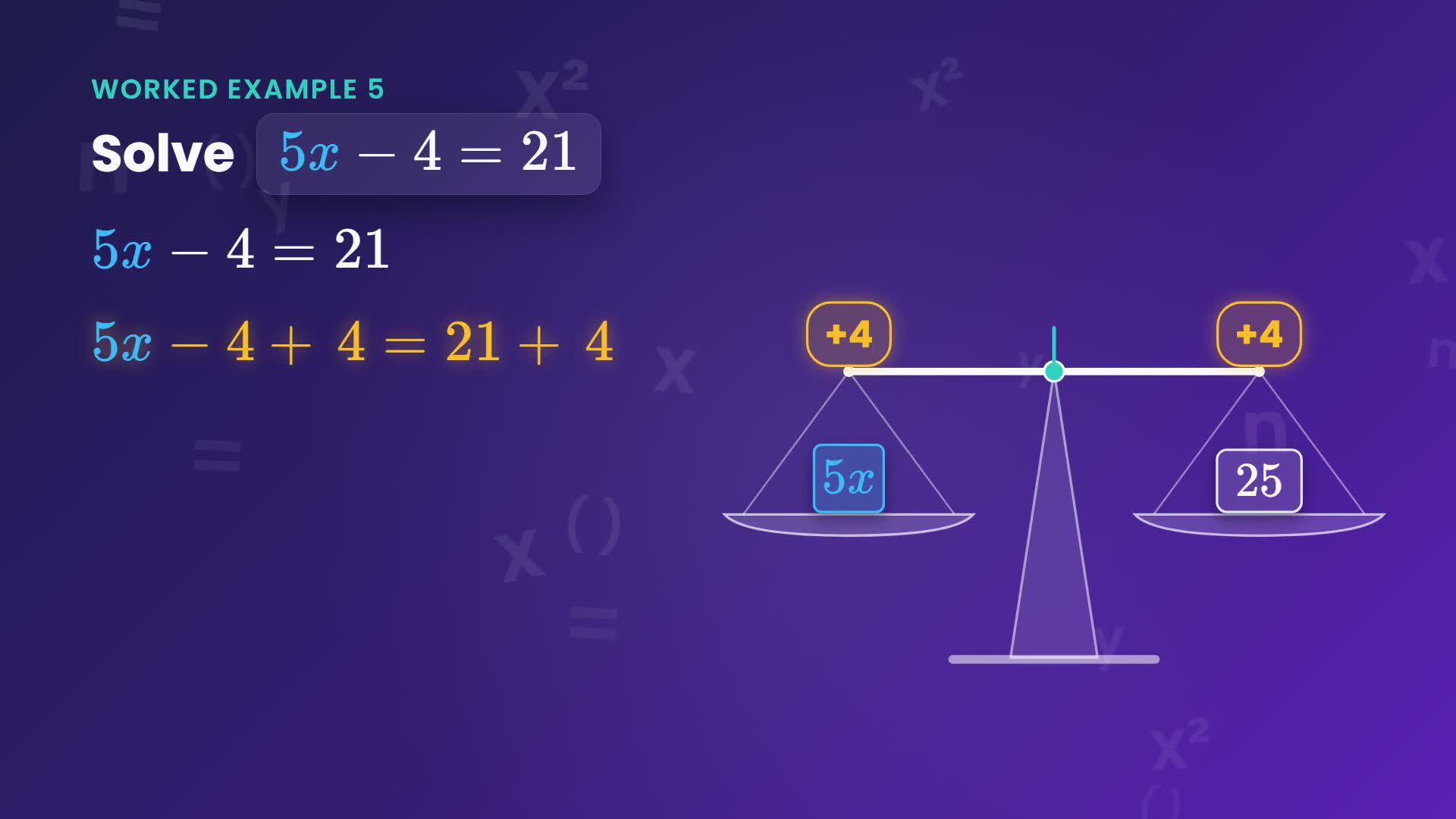
An equation is a balance: whatever you do to one side, do to the other
Undo operations with their inverse, in reverse order (undo + or − first, then × or ÷)
Always check by substituting your answer back in
Worked example
x + 9 = 15 → x = 6
4x = 28 → x = 7
x/5 = 3 → x = 15
Opening problem: 3x + 7 = 31 → 3x = 24 → x = 8 (check: 3 × 8 + 7 = 31 ✓)
5x − 4 = 21 → 5x = 25 → x = 5
4(x − 2) = 20 → x − 2 = 5 → x = 7 (also show expanding first: 4x − 8 = 20 → 4x = 28 → x = 7)
2x + 3 = 10 → 2x = 7 → x = 3.5 (answers don't have to be whole numbers)
Try it yourself: (a) 6x − 5 = 13 → x = 3 (b) (x + 4)/3 = 5 → x + 4 = 15 → x = 11
Exam tips
Common mistake: 3x + 7 = 31 → 3x = 38 ✗ (added 7 instead of subtracting).
Remember: keep the balance; inverse operations in reverse order; check your answer.
Resources
- No questions yet. Be the first to ask!
The full transcript is available with the lesson.