
Expanding single and double brackets
Learning objectives
- Expand single brackets
- Expand and simplify
- Expand two brackets
This lesson on expanding brackets shows you how to expand single brackets, expand and simplify, and expand two brackets. It is tested on both the Foundation and Higher tiers of Edexcel IGCSE Maths A (4MA1), and the video builds each method step by step from a real problem. The video opens with this problem: a rectangle is 4 wide and x + 3 long. Its area can be written two ways: 4(x + 3) or 4x + 12.
What you will learn
Multiply every term inside the bracket by the term outside
A negative number outside changes the sign of every term inside
Expand and simplify: expand each bracket, then collect like terms
Two brackets: use a 2 × 2 grid, multiply each part, then collect like terms
Worked example
4(x + 3) = 4x + 12
3(2a − 5) = 6a − 15
−2(y − 4) = −2y + 8
x(x + 7) = x² + 7x
3(x + 2) + 2(x − 5) = 3x + 6 + 2x − 10 = 5x − 4
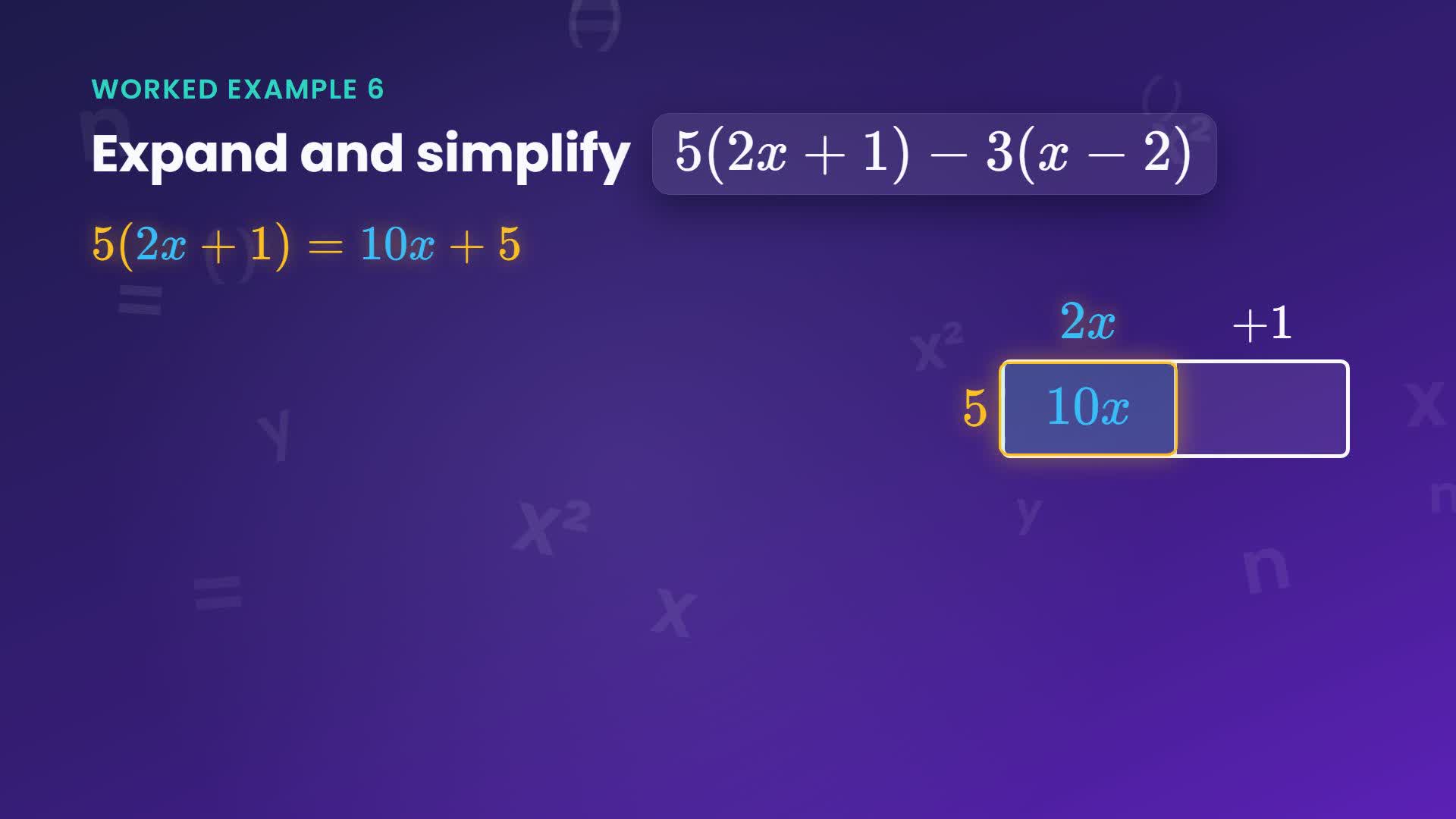
5(2x + 1) − 3(x − 2) = 10x + 5 − 3x + 6 = 7x + 11
Try it yourself: (a) 2(3x − 1) − 4(x + 2) = 6x − 2 − 4x − 8 = 2x − 10 (b) (x + 6)(x − 1) = x² + 5x − 6
Exam tips
Common mistake: 4(x + 3) = 4x + 3 ✗ (only the first term multiplied). Also −3(x − 2) = −3x − 6 ✗, because negative × negative is positive: −3x + 6 ✓.
Remember: multiply everything inside; watch the signs with a negative outside; grid for two brackets; always collect like terms at the end.
Resources
- No questions yet. Be the first to ask!
The full transcript is available with the lesson.